Breaking Boundaries in STEM: Meet Freja, Velindre's First Female Linear Accelerator Engineer
8 March 2026
For International Women’s Day, we’re celebrating the women across Velindre Cancer Service who are pushing boundaries, lifting others up, and making a real difference every day.
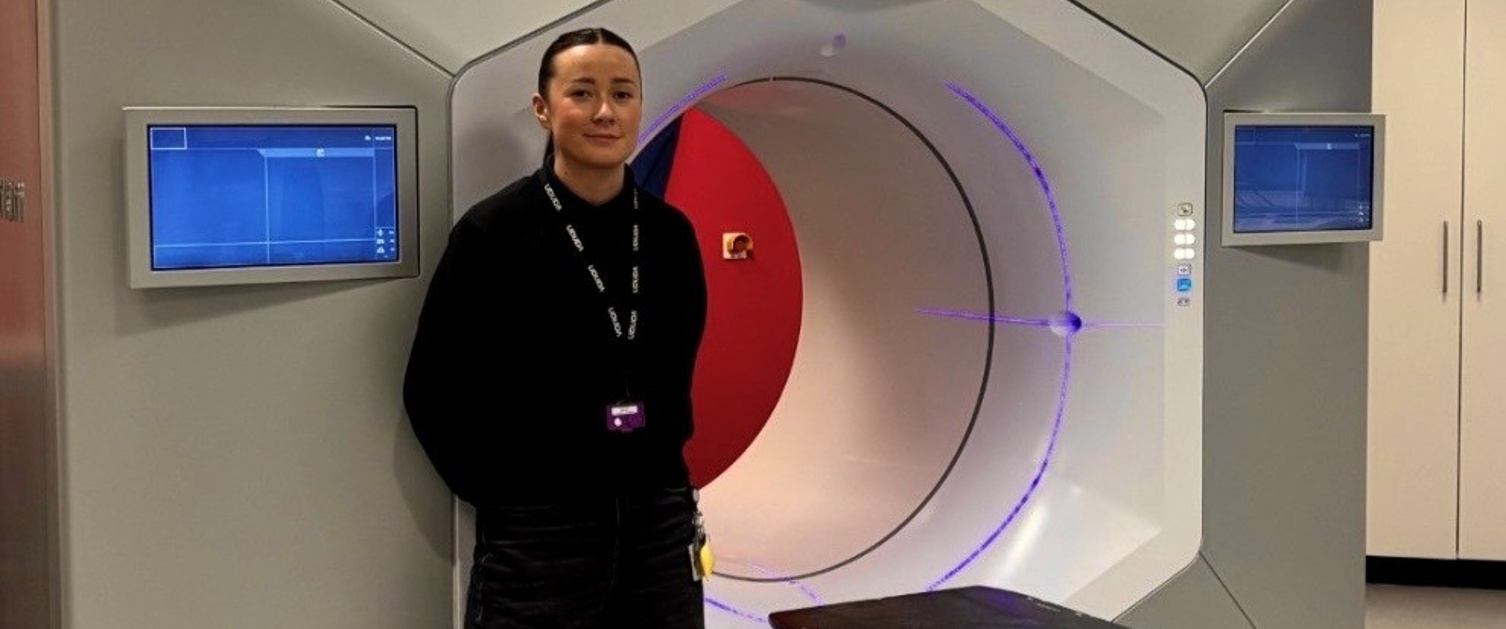
One of those trailblazers is Freja, Velindre’s first ever female Linear Accelerator (Linac) Engineer - a role critical to delivering safe and accurate radiotherapy treatment for our patients. We spoke with her about her experience as a women studying and working in a STEM (Science, Technology, Engineering and Maths) field.
Freja's journey into engineering began, as she says, with one simple habit: asking why. “I’ve always been interested in science and maths, since I was a child,” she laughs. “I always used to ask why about absolutely everything. Engineering just made sense.”
After taking Maths and Biology at A level, she moved on to Swansea University to study Medical Engineering, followed by a Masters degree in Medical Radiation Physics. While she knew she wanted to work with medical equipment, she didn’t initially set out to specialise in Linear Accelerators. “I didn’t even realise there were roles focused purely on this,” she says. “Medical engineering is broad - you can go into design, medical devices, so many routes. But the Masters definitely pushed me more towards oncology.”
Freja started working for Velindre Cancer Centre in May 2025, and she’s never looked back.
Navigating male‑dominated spaces throughout her education, Freja often found herself one of only a few women in her cohort. “First‑year engineering modules were shared with aerospace and civil engineering students, and those classes were almost all men. You definitely feel like a minority.” However, Freja found that this also created camaraderie. “The girls on the course naturally stuck together. We had group chats and supported each other through the tough modules; there was a real sense of solidarity.”
Joining an all-male engineering team was daunting, but Freja was overwhelmed by the support she received from her colleagues. “I’m in a male‑dominated team, but honestly, they’ve been fantastic,” she says. “I’ve never been made to feel different.”
And the rest of the Cancer Service has made an impact too. “When I’m working on the machines, the radiographers - especially the women - often say how happy they are to see a female engineer. Some have worked here for years and never seen one before. It’s lovely.”
Freja's message for girls and young women considering STEM? "Don’t be put off if a subject or a job feels male‑dominated. Don’t feel disheartened. Break boundaries. It’s 2026: if you want to be an engineer and wear site trousers and steel‑toe caps - do it.”
To Freja, the heart of the job isn’t the machines - it’s the people. “There’s such a friendly community feel at Velindre,” she says. “Lots of young people, lots of positivity.” But the most meaningful part of her work happens quietly, in the background. “Every time I hear the bell ring when a patient finishes treatment, it reminds me why we do this. Even though we’re not patient‑facing, engineers play such a vital role in the patient journey. I genuinely feel like I make a difference to people’s lives, and you can’t beat that feeling.”
Freja’s story is one of curiosity and courage to try something new - qualities we honour at Velindre this International Women’s Day. By stepping into a space where no woman at Velindre has been before, she’s not only excelling in her role; she’s helping demonstrate our commitment to creating opportunities for everyone, regardless of background or gender. Her journey reflects our ambition to open doors, champion diversity, and ensure that future generations of women can see engineering - and every part of Velindre Cancer Service - as a place where they belong.
Dr Samantha Warren, Head of Radiotherapy Physics at Velindre Cancer Service, said:
"Freja is a great example of how to follow your own interests, even if there don't (at first) seem to be many role models. But I've often found it easier than I imagined to meet supportive colleagues and friends once you start working in a field you really enjoy. Freja's story also highlights rewarding jobs in healthcare available to scientists, engineers and technicians, which aren't always recognised as being so vital in cancer care."
Velindre University NHS Trust, Unit 2,Charnwood Court, Parc Nantgarw, Nantgarw, Cardiff, CF15 7QZ
Tel: 029 2019 6161


