General information about having Radiotherapy at Velindre @ Nevill Hall
This booklet provides you with information about having radiotherapy treatment at Velindre @ Nevill Hall.
Contact telephone numbers are listed at the end of the booklet.
Please bring a list of your current medication each time you come to Velindre @ Nevill Hall.
Patient information is also available on the Velindre website.
Please go to www.velindre.nhs.wales/velindrecs
Smoking is not allowed within the grounds or inside Velindre @ Nevill Hall. If you would like help giving up, please ask.
What is Radiotherapy?
Your doctor has decided that you would benefit from a course of radiotherapy treatment.
Radiotherapy is a treatment for cancer using high energy radiation, usually x-rays. The type and amount of radiation that you receive is calculated to damage the DNA in cancer cells. This stops them from dividing properly so they are destroyed. Your treatment is planned to avoid as much healthy tissue as possible. However, some healthy tissue is affected which can cause side effects. This information will be explained by your doctor, and you may receive a separate booklet related to your cancer.
The Velindre @ Nevill Hall Radiotherapy team
The doctor responsible for your care is called a Clinical Oncologist. They will prescribe your radiotherapy treatment. This will be planned by a team of physicists and planning radiographers.
You will meet a team of therapeutic radiographers:
- Planning radiographers – perform your CT planning scan.
- Treatment radiographers – give you your treatment.
- Review, information, and support radiographers – give you advice on any side effects. They can also prescribe medication to help. They will provide information and advice on any practical, financial, or emotional concerns that you may have during your treatment.
Velindre @ Nevill Hall is a teaching hospital so your team may include students in training. If you don't want a student present during your appointments, please tell us.
Transport to and from Velindre @ Nevill Hall
If you need hospital transport, please give us as much notice as possible to arrange this for you. There is a high demand for transport so you will need to be prepared to wait for some time to be picked up and taken home. Some local support groups can also arrange transport. Patients on particular benefits can claim travelling expenses, please ask when you come for your treatment.
Information to let us know about before starting.
It is important you do not get pregnant during your treatment as radiotherapy can harm a developing baby. If you think you may be pregnant at all, please tell the radiographers straight away.
If you have a cardiac implanted electronic device (CIED) such as a pacemaker or defibrillator you must tell your doctor or a radiographer before or during your first planning appointment.
Arriving at the Department
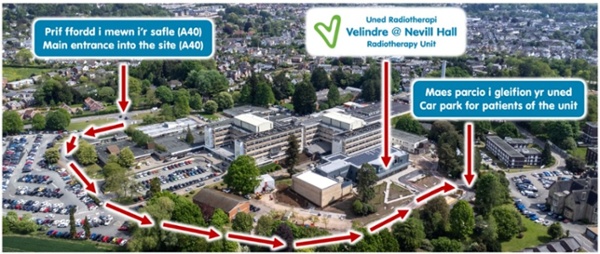
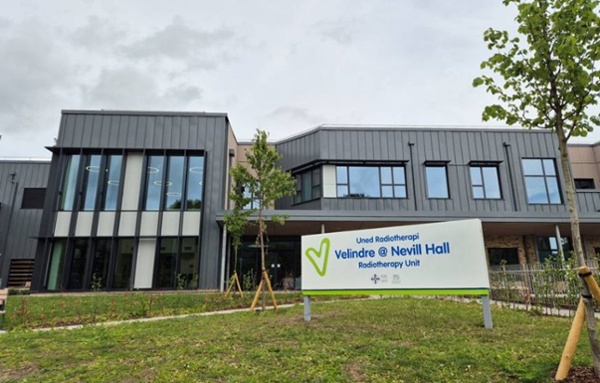
The Velindre @ Nevill Hall Radiotherapy Unit is located at the back of Nevill Hall Hospital. Please follow the one-way road around to the back of the hospital and signs for Velindre @ Nevill Hall Radiotherapy Unit. When you arrive at the Radiotherapy Unit by car, please drive into the car park on the opposite side of the building and drive up to the barrier at the entrance to the car park. The barrier will be clearly signposted. Stop at the barrier and use the intercom button to speak to a member of staff. Let them know you are attending an appointment, and they will raise the barrier to allow you through. The pedestrian crossing will take you across to the entrance to the Velindre @ Nevill Hall Radiotherapy Unit. Please enter the reception to check in where you will be directed to the required area for your appointment. Please bring your appointment letter with you.
Planning your Radiotherapy
For your planning scan will be asked to lie still on a hard couch. To help you maintain your position we will use plastic moulds and foam/rubber cushions, which can be repositioned at your planning scan. This position cannot be changed during treatment, so it is important that you are comfortable. Please let the radiographers know if you are not, so adjustments can be made. If you find laying down flat painful, it is important to bring pain relief with you.
The couch will be moved through the hole in the machine and may stop at different positions to take the planning scan. The radiographers will leave the room to switch the machine on but will always be watching you. The scan can be stopped at any time by letting the radiographers know by raising your arm or giving a wave. You do not see or feel anything during the scan.
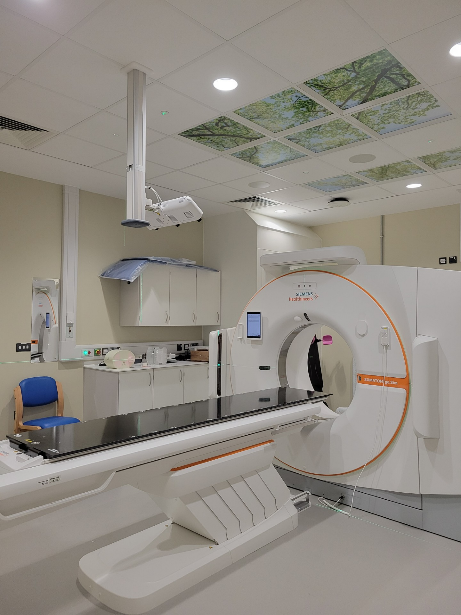
This is the CT scanner that Velindre @ Nevill Hall uses for treatment planning.
Different treatment areas have different set-up positions.
Breast – Your arms will be above your head, but your mobility will be checked beforehand, and equipment can be adjusted to make this easier.
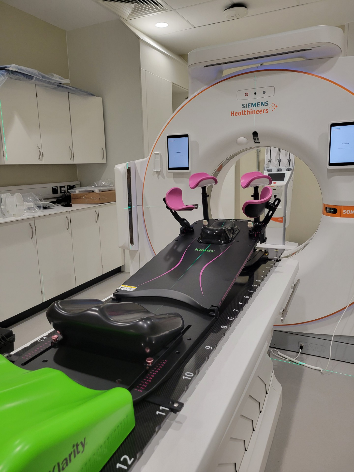
Pelvis – You will lie on your back on the couch with your arms across your chest. It is very important that you drink plenty of water before coming to your appointments, especially if your appointment is in the morning. Please eat as normal.
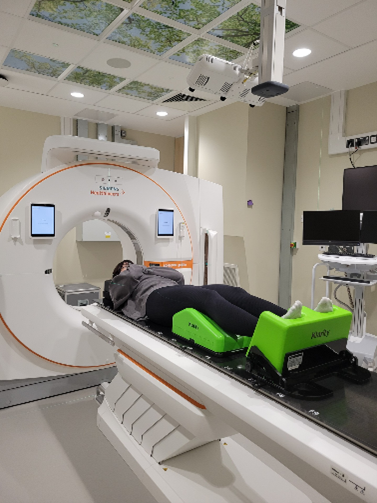
We plan your treatment to fit you and may be different from the ones explained in this booklet.
You may have markings on your skin to help the radiographers position you for your radiotherapy treatment. These are usually small permanent markings that are often called tattoos. If you are concerned about having permanent markings on your skin, please discuss this with your radiographer.
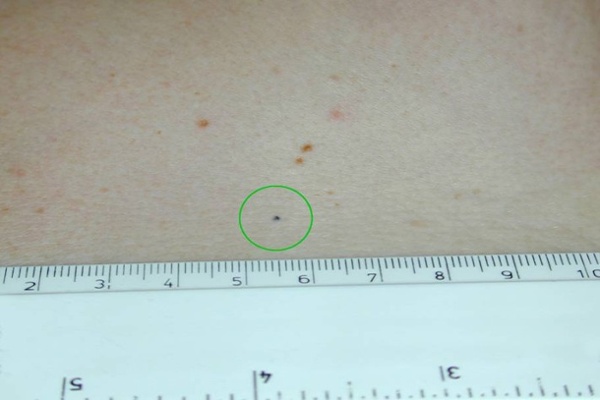
Permanent treatment tattoo
During your planning scan you may have an injection of dye into your vein, called contrast. This can help the doctor see some areas more clearly when they are planning your treatment.
Your planning appointment can last up to 2 hours due to any preparations needed beforehand. The planning scan itself should only last 15-30 minutes. You will also have an ID photo taken at this appointment which will be used throughout your treatment.
Treatment can be given the same day, a few days or a few weeks after your planning CT scan depending on the reason for your treatment, your oncologist will explain this to you. You may be given your first appointment at your planning appointment. If not, it will be sent in the post to you.
Having your Radiotherapy
There are 2 radiotherapy machines labelled ETHOS 1 and ETHOS 2, where you will re-create your position at your planning CT scan.
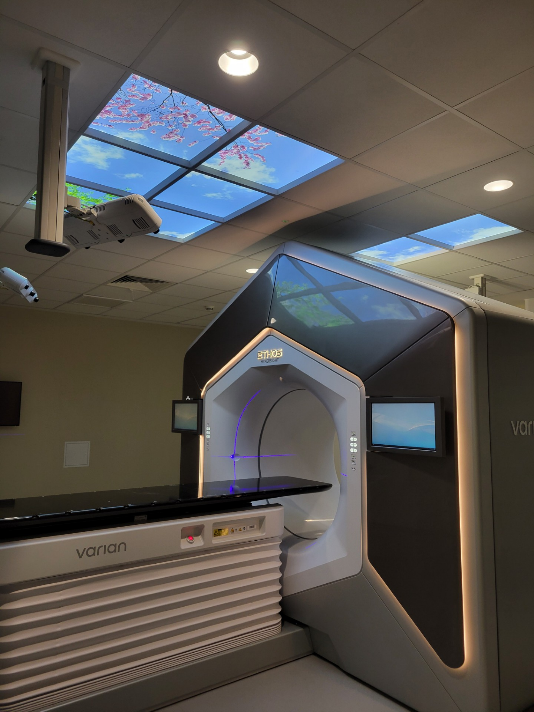
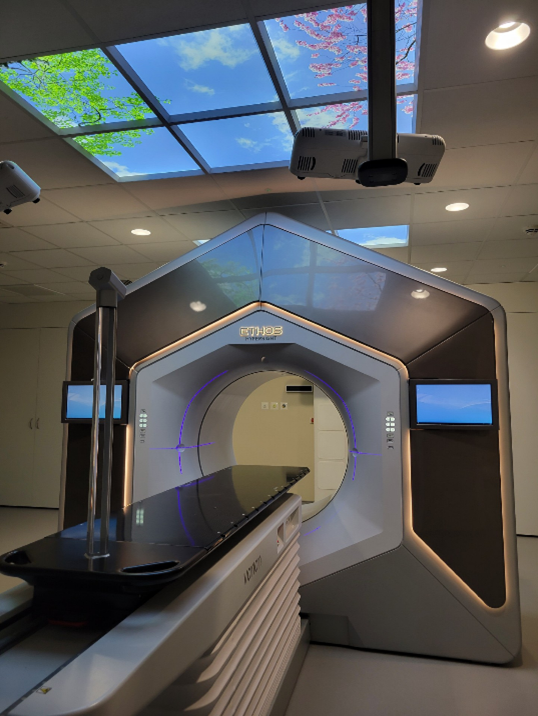
Radiotherapy is usually given over a number of treatment sessions; the number of sessions will depend on the type of cancer you have and the aim of the treatment.
Each treatment session can take between 10 – 30 minutes. Most of the time is spent getting you in the same position you were in for your CT planning scan. The treatment itself usually only takes a few minutes.
To get you in the correct position, the radiographers will use the markings on your skin made at your planning scan. It is important you feel comfortable as you will need to lie still for your treatment. Once you are in the correct position, the radiographers will leave the room to switch the machine on. They will be watching you on a camera. The treatment can be stopped at any time by letting the radiographers know by raising your arm or giving a wave.
You will not see or feel anything when the machine is switched on, but you may hear a buzzing noise as the machine operates. The radiographers will take regular scans and pictures throughout your treatment. This is to make sure the treatment is being given correctly, rather than to show how the treatment is going.
Once the treatment session has finished, the radiographers will come back into the room. It is important you stay in the same position until the radiographers tell you it is safe to get off the couch. After this, you can go about your normal day or go back to the ward if you are an inpatient.
If you would like to watch how radiotherapy is given at Velindre, please go to www.youtube.com/user/Velindrecc.
Side effect information will be provided to you either in a separate booklet/leaflet, explained by your consultant and given on your consent form.
If you would like talk to someone about your radiotherapy treatment, please contact the Radiotherapy Review Clinic (please see contact list below).
What can I expect after treatment has finished?
Radiotherapy has a delayed effect in which the side-effects will continue even after your treatment has finished. They tend to reach their peak around 7 to 14 days after your last radiotherapy session, so don’t be alarmed if they worsen.
Recovery times vary from person to person, but side-effects should gradually improve over the following 6 to 12 weeks.
In the weeks following your treatment, you will be reviewed by the specialists that have been looking after you. This will vary depending on your diagnosis and treatment regimen, but you will be advised on this by your treatment team.
Everyone is different and may react differently to treatment. If at any point, after you have finished treatment, you are concerned about anything please contact your radiotherapy team or your GP. It is not unusual for people to be anxious, and it might be better to seek advice rather than worry.
Contact Telephone Numbers for Radiotherapy
For your appointments and hospital transport:
Radiotherapy booking clerks: 02920 196 836
Velindre @ Nevill Hall Main Reception: 02920 035 700
Velindre @ Nevill Hall Radiotherapy planning department: 02920 196 285
For treatment information and advice:
Radiotherapy Review Team: 0292061 5888 ext 6421
Local charities providing transport:
Transport from Aberdare:
Rowan Tree Cancer Care 01443 479369
Transport from Merthyr:
Cancer Aid 01685 379633
Supportive Care Team at Velindre Cancer Centre
Benefits and welfare rights: 02920 316277
For local support groups, carers/family support, befriending services, spiritual care and talking to children: 02920 196132
Helplines and websites
Macmillan cancer support helpline: 08088080000 9am–8pm
Website:www.macmillan.org.uk
Maggie’s Cardiff. 9am- 5pm Helpline : 02922408024
Website : www.maggies.org/our-centres/maggies-cardiff/
Tenovus Helpline: 0808 808 1010 8am – 8pm
Website: www.tenovuscancercare.org.uk
Stop Smoking Wales – Help Me Quit Helpline: 0808 278 4105
Website: www.helpmequit.wales